
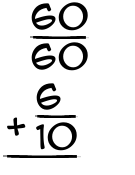
What is 60/60 + 6/10?
|
This is how we add
|
||||||||||||||||||||||||||||||||
Step 1Our denominators (bottom numbers) don't match, so we can't add yet. Since 10 is evenly divided by 60, we can multiply just one term to get a common denominator. Multiply 6 by 6, and get 36, then we multiply 10 by 6 and get 60. So now our fractions look like this:
|
||||||||||||||||||||||||||||||||
Step 2Since our denominators match, we can add the numerators. 60 + 36 = 96 So the answer is:
|
||||||||||||||||||||||||||||||||
Step 3Last of all, we need to simplify the fraction, if possible. Can it be reduced to a simpler fraction? To find out, we try dividing it by 2... Are both the numerator and the denominator evenly divisible by 2? Yes! So we reduce it:
Now, try the same number again. Are both the numerator and the denominator evenly divisible by 2? Yes! So we reduce it:
Now, try the same number again. Nope. Try the next prime number, 3... Are both the numerator and the denominator evenly divisible by 3? Yes! So we reduce it:
Now, try the same number again. Nope. Try the next prime number, 5... Nope. Try the next prime number, 7... No good. 7 is larger than 5. So we're done reducing. Congratulations! Here's your final answer to 60/60 + 6/10
|