
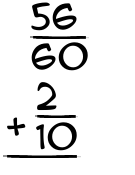
What is 56/60 + 2/10?
|
This is how you add
|
|||||||||||||||||||||||||
Step 1We have to make sure the denominators are equal. Since 10 is evenly divided by 60, we can multiply just one term to get a common denominator. Multiply 2 by 6, and get 12, then we multiply 10 by 6 and get 60. So now our fractions look like this:
|
|||||||||||||||||||||||||
Step 2Since our denominators match, we can add the numerators. 56 + 12 = 68 So the answer is:
|
|||||||||||||||||||||||||
Step 3Last of all, we need to simplify the fraction, if possible. Can it be reduced to a simpler fraction? To find out, we try dividing it by 2... Are both the numerator and the denominator evenly divisible by 2? Yes! So we reduce it:
So far so good... let's try to divide by that number again. Are both the numerator and the denominator evenly divisible by 2? Yes! So we reduce it:
So far so good... let's try to divide by that number again. No good. So next you try the next prime number, which is 3... No good. So next you try the next prime number, which is 5... No good. So next you try the next prime number, which is 7... No good. So next you try the next prime number, which is 11... No good. So next you try the next prime number, which is 13... No good. So next you try the next prime number, which is 17... No good. 17 is larger than 15. So we're done reducing. And we're done! Here's the final answer to 56/60 + 2/10
|