
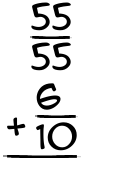
What is 55/55 + 6/10?
|
Here's how to add
|
||||||||||||||||||||||||||||||||
Step 1Of course, you can't add two fractions if the denominators (bottom numbers) don't match. To get a common denominator, multiply the denominators together. Then we fix the numerators by multiplying each one by their other term's denominator. Now you multiply 55 by 10, and get 550, then we multiply 55 by 10 and get 550. Do the same for the second term. We multiply 6 by 55, and get 330, then multiply 55 by 10 and get 550. The problem now has new fractions to add:
|
||||||||||||||||||||||||||||||||
Step 2Since our denominators match, we can add the numerators. 550 + 330 = 880 The sum we get is
|
||||||||||||||||||||||||||||||||
Step 3The last step is to reduce the fraction if we can. To find out, we try dividing it by 2... Are both the numerator and the denominator evenly divisible by 2? Yes! So we reduce it:
Let's try dividing by that again... Nope! So now we try the next greatest prime number, 3... Nope! So now we try the next greatest prime number, 5... Are both the numerator and the denominator evenly divisible by 5? Yes! So we reduce it:
Let's try dividing by that again... Nope! So now we try the next greatest prime number, 7... Nope! So now we try the next greatest prime number, 11... Are both the numerator and the denominator evenly divisible by 11? Yes! So we reduce it:
Let's try dividing by that again... No good. 11 is larger than 8. So we're done reducing. There you have it! Here's the final answer to 55/55 + 6/10
|